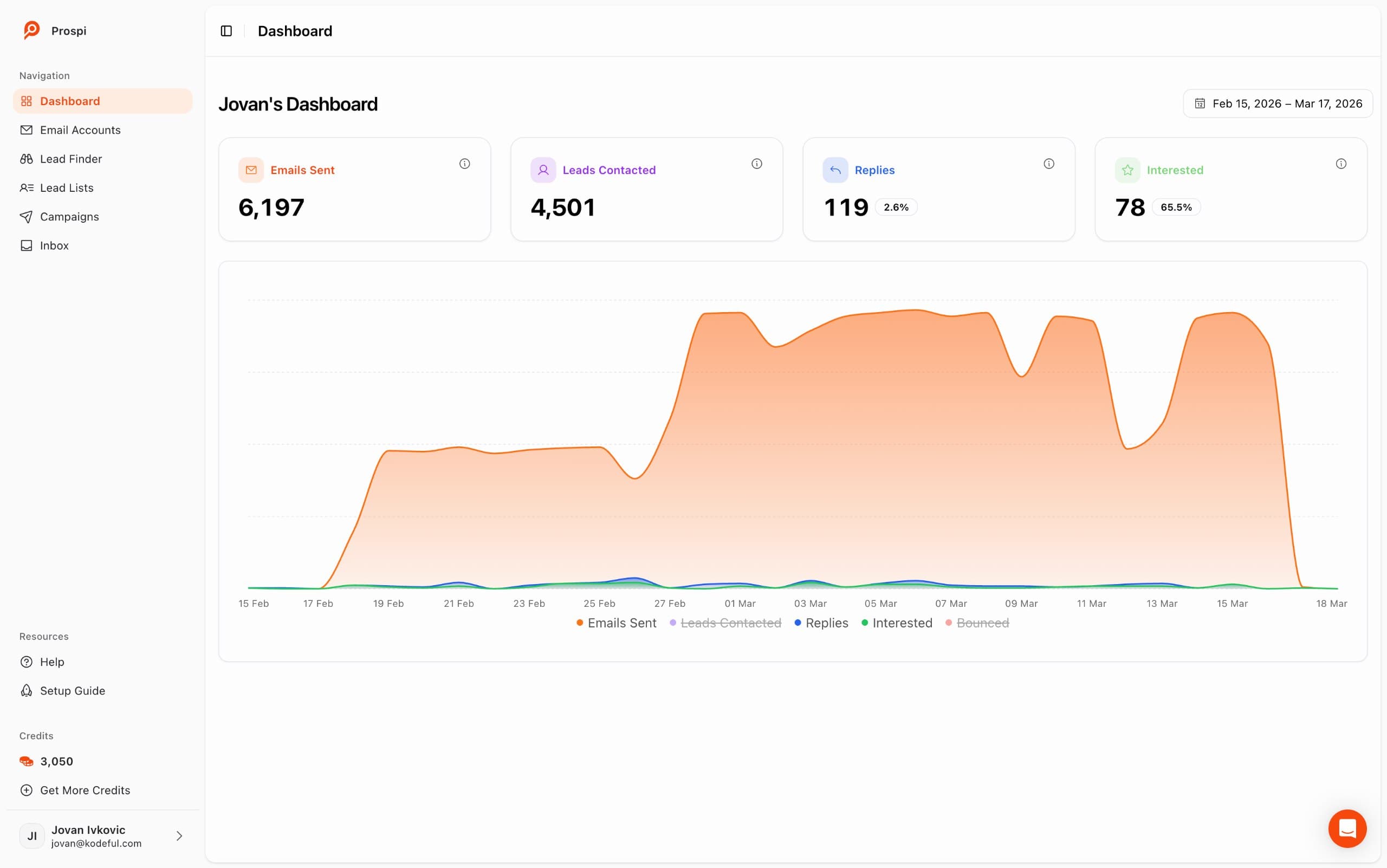

Most people think cold email is about writing the perfect first message. It's not. Data from Woodpecker's analysis of 20 million cold emails shows that sending at least one follow-up increases reply rates by 65.8%. Campaigns that include 4-7 follow-ups generate 3x more replies than campaigns with just 1-3.
The reality of B2B sales is that decision-makers are buried in email. Your first message might arrive on a Monday when they're in back-to-back meetings. It might land the same day they're dealing with a budget crisis. It might just get buried. A well-timed follow-up isn't annoying — it's a second chance at the right moment. This guide covers exactly how to build a cold email follow up sequence that consistently generates replies and booked meetings.
How Many Follow-Ups Should You Send?
The data points to a clear sweet spot: 4 follow-ups after your initial email, for a total sequence of 5 emails. HubSpot research found that 80% of sales require at least 5 touchpoints before a prospect converts. Yet 44% of salespeople give up after just one follow-up.
Here's how reply rates are distributed across a typical 5-email sequence based on industry benchmarks:
Beyond 5 emails, diminishing returns kick in fast. You're spending effort on prospects who have seen your offer multiple times and chosen not to respond. More importantly, sending too many follow-ups increases spam complaint rates, which hurts deliverability for your entire domain. See our deliverability guide for why this matters.
What Is the Ideal Timing Between Follow-Ups?
Timing is one of the most debated topics in cold email strategy. Send too soon and you seem desperate. Send too late and you lose momentum. The framework below is derived from aggregate data across thousands of outbound campaigns run through Prospi.
Day of week and send time also matter. Woodpecker's send time analysis shows that Tuesday and Wednesday between 8am-11am in the recipient's local time zone consistently outperform other windows. Avoid Monday mornings (inbox overload from the weekend) and Friday afternoons (mental checkout mode).
When using an automated platform like Prospi, you can set time-zone-aware delivery so each follow-up arrives during business hours regardless of where your prospects are located. This alone can improve open rates by 20-30% compared to bulk-sending at a fixed UTC time. Learn more in our AI personalization feature overview.
What Should Each Follow-Up Email Say?
The single biggest mistake in cold email follow up is sending a reminder that adds no value. "Just following up on my last email" is not a follow-up strategy — it's a desperation signal. Every email in your sequence needs to earn the prospect's attention with something new.
Think of each follow-up as a different angle on the same problem. Your initial email might focus on the outcome you deliver. Follow-up 1 can address a common objection. Follow-up 2 can share a relevant case study. Follow-up 3 can try a completely different use case or persona. Follow-up 4 (the break-up) creates urgency by signaling you're removing them from your sequence.
Keep follow-ups shorter than your initial email. If your opener was 100-150 words, aim for 60-90 words in follow-ups. Busy executives give follow-ups even less time than cold openers — get to the point in the first sentence. See our guide on how to write cold emails for the foundational principles that apply to every email in your sequence.
What Is a Proven 5-Step Follow-Up Sequence?
Here is a battle-tested sequence structure used across high-performing Prospi campaigns. Each email has a distinct purpose and angle. Customize the specifics for your offer, industry, and ICP — but keep the structure.
Subject: [Result] for [Company type] — quick question
Hi [First name],
[Personalized opening line — something specific to their company or role.]
We help [ICP description] [achieve specific outcome] without [common pain/sacrifice].
[One-line social proof: e.g., "We've done this for 40+ [industry] companies including [recognizable name]."]
Worth a 15-min call to see if it's a fit?
Subject: Re: [original subject]
Hi [First name],
Wanted to bump this in case it got buried. The most common concern I hear from [role] at companies like yours is [common objection] — so I wanted to address it upfront.
[Two-sentence objection reframe or clarification.]
Does [specific day/time] work for a quick call?
Subject: Re: [original subject]
[First name],
Quick one — [similar company] was dealing with [same problem] before working with us. In [timeframe], they [specific result: e.g., "booked 34 qualified meetings"].
[One sentence connecting their specific situation to the outcome.]
Happy to share the details on a call — 15 minutes enough?
Subject: Re: [original subject]
[First name],
I've been reaching out about [original use case], but I realized there might be a more relevant angle for [Company]: [alternative use case or department benefit].
[One-sentence explanation of the alternative value.]
Is this something you'd want to explore?
Subject: Re: [original subject]
[First name],
I'll stop reaching out after this — I don't want to clog your inbox if this isn't the right time.
If [problem you solve] ever becomes a priority, feel free to reach out or book time here: [calendar link].
Either way, best of luck with [something specific to their company or role].
The break-up email consistently outperforms all other follow-ups in terms of reply rate because it triggers a psychological response. Telling someone you're leaving removes the pressure and often surfaces a reply that was sitting dormant — "Wait, actually, let's talk." Build and automate sequences like this with Prospi's sequence builder.
Should You Change the Subject Line in Follow-Ups?
For most cold email sequences, reply in the same thread. This keeps context visible for the prospect, signals an ongoing conversation to spam filters, and reduces the cognitive load of a new subject line appearing in their inbox. Most email automation platforms — including Prospi — default to threaded follow-ups for this reason.
That said, there are specific scenarios where a new subject line makes sense:
- Your initial email had a weak subject line with low opens — a new subject line lets you test a better hook
- You are pivoting to a completely different angle or use case in a later follow-up
- It has been 14+ days since the last touch and the thread feels cold or stale
- You want to reach the prospect as if starting fresh after a long gap
A/B testing subject line strategy is one of the most impactful optimizations you can make once your sequence structure is solid. Prospi's built-in A/B testing lets you split test subject lines across active sequences and automatically shifts sends toward the winner. Combined with AI-powered personalization, this can push open rates well above the 50-60% benchmark for top cold email senders.
How Do You Handle "Not Interested" Replies?
Negative replies are a normal and healthy part of any cold email program. Getting a "not interested" reply is far better than getting no reply at all — it keeps your domain engagement signals positive and gives you actionable data. Here is how to handle each type.
The "wrong person" reply is one of the most underutilized opportunities in cold email. When someone tells you they're not the right contact, you have a warm introduction waiting to happen. A simple "Thanks for letting me know — who on your team handles [relevant function]? Happy to reach out to them directly" converts at a remarkably high rate. It's essentially a warm intro from someone inside the company.
For timing-based objections ("not the right time," "ask me in Q3," "we're in a hiring freeze"), always confirm the re-engagement date explicitly. "I'll follow up in Q3 — should I circle back around July 1st?" locks in a specific date and sets the expectation for both sides. Log this in your CRM and set a reminder — these warm re-engagements close at significantly higher rates than cold outbound. See our pricing page for CRM integration options. If you are also running LinkedIn outreach alongside your email sequences, our cold email vs LinkedIn comparison covers how to sequence both channels for maximum results.
Frequently Asked Questions
How many cold email follow-ups should you send?
Research consistently shows that 2-5 follow-up emails produce the best results. Most replies come on the 2nd or 3rd touch. Sending more than 5 follow-ups produces diminishing returns and increases the risk of spam complaints. A 5-step sequence (initial email plus 4 follow-ups) captures the vast majority of interested prospects while respecting recipient preferences.
What is the best timing for cold email follow-ups?
The optimal spacing is: Day 1 (initial email), Day 3 (first follow-up), Day 7 (second follow-up), Day 14 (third follow-up), Day 21 (final follow-up). This spacing respects the prospect's schedule while maintaining enough frequency to stay top of mind. Avoid sending follow-ups on Mondays or Fridays — Tuesday through Thursday between 8am and 11am in the prospect's time zone tends to generate the highest reply rates.
Should cold email follow-ups be in the same thread?
Yes, in most cases follow-ups should be sent as replies to the original thread. This keeps context intact, makes it easy for prospects to reference your original email, and signals to spam filters that this is an ongoing conversation. Some advanced senders test standalone follow-ups with new subject lines to break through inbox noise, but threaded replies work better for most campaigns.
What should you write in a cold email follow-up?
Each follow-up should add a new value angle or change the approach. Follow-up 1 should be a simple bump with a softer ask. Follow-up 2 should add a new insight, case study, or data point. Follow-up 3 should try a different angle or use case. Follow-up 4 should be a concise break-up email that creates urgency. Never just say 'following up to my last email' — always bring something new.
Should you stop follow-ups if someone doesn't reply?
Yes — after your final planned follow-up (typically 4-5 emails), stop the sequence. No reply after 5 touches is a clear signal the timing is not right. Mark them as 'no response' in your CRM rather than 'not interested.' You can re-engage them in 3-6 months when your offer or their situation may have changed. Never continue sending unsolicited emails to someone who has not engaged.
The Bottom Line on Cold Email Follow Up
Cold email follow up is not optional — it is where the majority of your pipeline comes from. The difference between a 9% reply rate and a 28% reply rate is almost entirely explained by the presence and quality of follow-up emails. A 5-step sequence over 21 days, with each email adding distinct value and a different angle, is the single highest-leverage improvement most cold email senders can make.
The sequences that book the most meetings share three traits: they are personalized to the individual, they are timed intelligently around business hours and days, and they stop automatically the moment a prospect replies — whether positively or negatively. Automating this well requires infrastructure, not just willpower.
Prospi handles the entire follow-up lifecycle — from building multi-step sequences with AI-generated variations, to timezone-aware delivery, to instant opt-out processing. If you are running follow-ups manually or relying on a basic email tool, you are almost certainly leaving pipeline on the table. Start with the 5-step framework above and automate it with Prospionce you've validated the copy.